

Life doesn’t ask permission before it changes on you.
 One day you’re settled into a routine you know by heart, and the next you’re packing boxes for a new city, signing divorce papers, bringing a newborn home, moving your parents into your spare room, sitting in a doctor’s office trying to absorb a diagnosis, or standing at the altar about to become someone’s spouse. Big or small, chosen or not, transitions have a way of pulling the rug out from under our sense of who we are and what matters to us.
That disorientation is normal. It’s also exactly why values work — reconnecting with what actually matters to you — is one of the most grounding things you can do during a major life change.
Why Transitions Scramble Our Sense of Self
Psychologists have long understood that identity isn’t fixed — it’s built and rebuilt throughout our lives, especially during major life changes. When we go through a transition, the roles, routines, and relationships that used to anchor us often shift or disappear entirely. A new parent isn’t just tired; they’re renegotiating who they are now that “just me” has become “me and this tiny person.” Someone going through a divorce isn’t just handling logistics; they’re rebuilding an identity that was, for years, wrapped up in a partnership. A caretaker isn’t just managing a schedule; they’re absorbing a new role that can quietly crowd out everything else they used to care about.
In the middle of all that change, it’s incredibly common to lose touch with your own values — not because they’ve disappeared, but because there’s been no time or space to check in with them. You’re in survival mode, reacting to what’s in front of you instead of steering from what matters most to you.
This is where a guided values practice becomes more than a nice self-care exercise. It becomes a compass.
What It Means to “Get Your Values in Line”
Values aren’t the same as goals. Goals are things you achieve and check off. Values are the ongoing qualities you want to bring to your life — things like connection, honesty, growth, freedom, security, creativity, or service. When your daily choices are aligned with your values, life feels coherent, even when it’s hard. When they’re out of alignment, something feels off, even if you can’t quite name why.
Transitions are the perfect (if uncomfortable) opportunity to ask:
- Which of my values were shaped by circumstances that have now changed?
- What do I want to carry forward, and what am I ready to let go of?
- Am I making decisions right now based on what matters to me, or just on autopilot, fear, or other people’s expectations?
Without a structured way to explore these questions, most of us just… don’t. Life is loud, transitions are demanding, and quiet self-reflection tends to get pushed to “someday.” That’s the gap a good guided workbook can fill — making sure someday actually happens, in a doable, non-overwhelming way.
Who This Workbook Is For
I built this resource to flex across the many different chapters of life that call for realignment, including:
- Starting college — stepping into independence and figuring out your own identity, separate from family or hometown expectations
- Going through a divorce — rebuilding a sense of self after a major relationship shift
- Making a big move — recalibrating in a new environment, away from old routines and social circles
- Caretaking a loved one — staying connected to yourself while giving so much of your time and energy to someone else
- Facing a difficult diagnosis — reassessing what truly matters when health and time suddenly feel less guaranteed
- Getting married — merging two lives while making sure you don’t lose your own individual compass
- Becoming an empty nester — rediscovering who you are once the day-to-day of active parenting shifts
- Having children — expanding your identity to include this new role without losing the rest of yourself
Whatever the transition, the underlying need is the same: a chance to pause, reflect, and realign — instead of just white-knuckling through the change.
My Favorite Time to Use It
While the workbook is built to meet you in any transition, one of my own favorite times to pull it out has nothing to do with a big life event at all: the quiet week after the Christmas holiday, right before the new year begins.
There’s something about that stretch of days — the presents unwrapped, the gatherings winding down, the calendar about to flip over — that makes it the perfect natural pause point. It’s not a crisis. It’s just a chance to regroup. I use that week to sit down with the workbook, revisit my core values, and think honestly about the year ahead: what I want to carry forward, what I’m ready to leave behind, and what “living my values” actually looks like in the months to come. It’s become an annual ritual I genuinely look forward to.
Introducing the Living Your Values Workbook
This is exactly why I created the Living Your Values Workbook, a digital, editable download built to walk you through this process step by step.
As a clinical social worker, I’ve sat with people across every kind of life transition, and I’ve watched, over and over, what happens when someone finally slows down long enough to ask what actually matters to them. It changes everything — not by making the transition easier, but by giving them something solid to stand on inside of it.
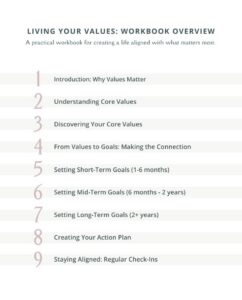
The workbook is organized into nine guided sections that move you from big-picture reflection all the way to a concrete, everyday practice:
- Why Values Matter — a grounding introduction to why values-based living (not just goal-chasing) is the real key to a fulfilling life, plus how to use the workbook at your own pace
- Understanding Core Values — the difference between a value and a goal, and how one flows into the other
- Discovering Your Core Values — guided reflection exercises (peak moments, role models, and a full values-clarification checklist) to help you surface what’s really important to you, followed by journaling space to narrow things down to your top 10, top 5, and 3–4 true non-negotiables
- From Values to Goals — bridging exercises across every area of life: career, relationships, health, personal growth, fun, service, finances, and living environment
- Short-Term Goals (1–6 months) — a simple S.M.A.R.T. goal template and planning worksheet
- Mid-Term Goals (6 months–2 years) — worksheets to map milestones, needed resources, and obstacles
- Long-Term Goals (2+ years) — visioning prompts for the legacy and life you want to build
- Creating Your Action Plan — turning goals into daily habits and an actual weekly schedule, so your values show up on your calendar, not just in your head
- Staying Aligned — daily, monthly, quarterly, and annual check-in templates to help you notice when you’ve drifted and gently course-correct
Every section includes guided, editable, printable pages with plenty of room to write, reflect, and revisit — so it’s just as useful six months from now as it is today.
Why This Matters More Than You Might Think
 We tend to treat life transitions as things to “get through.” But they’re also invitations — chances to consciously choose who you want to be on the other side, rather than just reacting your way there. This workbook doesn’t make the hard parts of transition disappear. What it does is give you something steady to hold onto while everything else is in motion.
If you’re in the middle of a shift right now — whatever kind — you don’t have to navigate it without a compass.
The Living Your Values Workbook is available now as an instant digital download for $18. It’s yours to keep and reuse as many times as you’d like — through this transition, your next one, and every New Year reset in between.
Start Working With an Online Therapist in Kentucky or Ohio!
Transitions are easier to move through when you’re not doing it alone. If you’re in the middle of big transitions and want support turning your values into daily practice, working with an online therapist gives you a steady place to begin. Reach out to schedule a session, or download the Living Your Values Workbook to start at your own pace. If you are ready to start working with a caring therapist at Thrive Therapy, follow these simple steps:
- Connect with us through our provider consultation page
- Meet with a caring therapist
- Start moving forward through life transitions at your own pace!
Other Services Offered with Thrive Therapy Inc.
Thrive Therapy Inc. supports clients across Kentucky and Ohio. Our team offers a range of services in-person and online therapy services. We are happy to offer trauma therapy, grief counseling, therapy for sexual assault survivors, first responders, and childhood trauma survivors. You can learn more by visiting our FAQ or blog pages today.